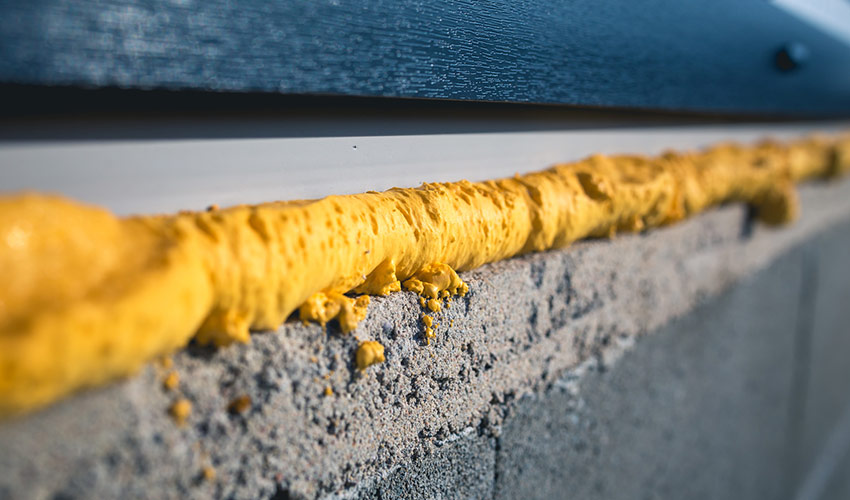
Polyurethane foam explained for Texas homeowners: how spray foam is made, open-cell vs closed-cell, R-values, safety, and where it fits in a house.
Polyurethane foam is a plastic made by mixing two liquids that react, expand and harden into a cellular solid. You've sat on it, slept on it and probably have a can of it in the garage. In home building, the version that matters most is spray polyurethane foam, often shortened to SPF. It's sprayed into walls, attics and gaps, where it swells to fill the space and sets up in seconds.
If a contractor has suggested spray foam for your attic, or you're comparing it against fiberglass and cellulose, it helps to know what the material actually is, how the two main types differ, and what it can and can't do in a Texas house.
Every polyurethane foam starts with two components. Installers call them the A side and the B side. The A side is an isocyanate, usually a type called MDI. The B side is a blend of polyols plus blowing agents, catalysts, flame retardants and other additives. Pumped through heated hoses and mixed at the spray gun, the two react within seconds. The reaction gives off heat, gas bubbles form, and the mix rises into foam before it cures into a solid.
The blowing agent decides a lot about the final product. Open-cell foam is usually blown with water, which reacts to form carbon dioxide. Closed-cell foam uses a blowing agent that stays trapped inside the cells, and newer products have moved to agents called HFOs that have a much lower impact on the climate than the older ones.
These are the two families you'll hear about, and they behave quite differently.
Open-cell foam is soft and spongy, about half a pound per cubic foot. Its cells are broken open, so air fills them. It insulates at roughly R-3.5 to R-3.8 per inch and expands a lot, around 100 times its liquid volume, which makes it good at filling odd cavities. It lets water vapor pass through, it deadens sound well, and it costs less per unit of R-value than closed-cell. In Texas attics, open-cell is the common choice for spraying the underside of the roof deck.
Closed-cell foam is dense and rigid, roughly two pounds per cubic foot. Its cells stay sealed, which gives it about R-6 to R-7 per inch. At an inch and a half to two inches thick it acts as a vapor retarder, and it adds some stiffness to the wall or roof it's bonded to. It also shrugs off water, which is why you see it in crawl spaces, rim joists and flood-prone areas near the coast. The tradeoff is price. You pay noticeably more per board foot.
Fiberglass and cellulose slow heat by trapping air in a fluffy layer. They do nothing to stop air from moving through cracks unless someone seals those cracks separately. Polyurethane foam does both jobs in one pass. Applied at the right thickness, it's an insulation layer and an air barrier at the same time.
That matters here because so much of a Texas cooling bill comes from leaks. Hot, humid air pulled in around can lights, top plates, plumbing holes and attic chases makes the AC work twice: once to cool it and again to pull the moisture out. Foam closes those paths.
A few other traits come with the material:
Spray foam is only one form. Rigid polyurethane and its close cousin polyisocyanurate (polyiso) come as foil-faced boards used on roofs and walls. One-part foam in a can fills small gaps around pipes and window frames. Flexible polyurethane foam ends up in mattresses, couches and carpet pad. Same chemistry family, very different jobs. When people in the trade say polyurethane foam insulation, though, they nearly always mean two-component spray foam.
While it's being sprayed, and for a while after, spray foam gives off isocyanate vapors that can irritate the lungs, eyes and skin. Repeated exposure can make some people sensitive to it. That's why installers wear full suits and supplied-air respirators, and why the people living in the house should stay out until the foam has cured and the space has been aired out. Each manufacturer sets the re-entry time for its product, and 24 hours or more is common.
Once fully cured, the foam is stable. Most complaints about a lingering odor trace back to an off-ratio mix or spraying at the wrong temperature, which is one reason equipment and installer skill matter so much with this product. Our article on applying spray foam safely covers the precautions in more detail.
Polyurethane foam shines when a house has a lot of air leakage or an attic full of ductwork. Spraying open-cell foam under the roof deck brings the ducts and air handler inside the insulated part of the home, so they're no longer sitting in 140 degree air all summer. It makes less sense in a home with a simple, well-sealed attic floor and no ducts overhead. There, blown insulation to R-38 or R-49 usually does the job for a lot less money.
For the specific places to use it and what a job involves, see where spray polyurethane foam makes sense, or browse the rest of our spray foam articles.
Foam is a big decision, and it isn't the answer for every house. Texas Energy Pros offers a free home energy audit that looks at your attic, your ducts and where the air is leaking. You'll know whether spray foam, blown insulation or a mix of the two fits your home before you spend anything. Contact us to set it up.